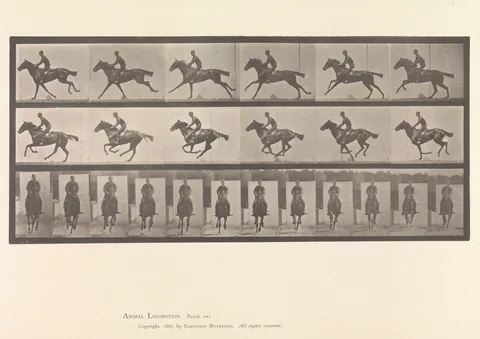
Follow one hoof across the printed page
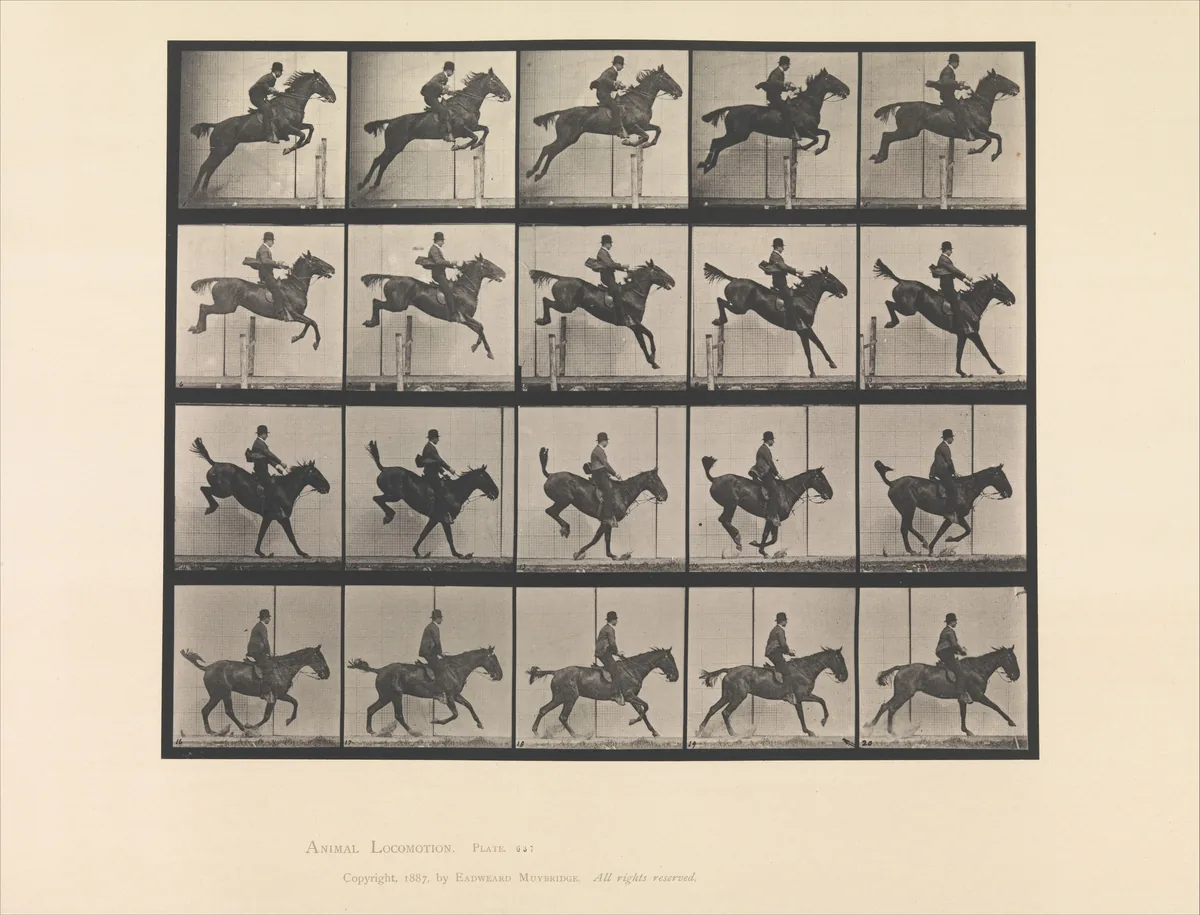
Begin with the top row of Horse and Rider Galloping. Cover all but two neighboring pictures and follow just one hoof. Its position changes relative to the animal’s chest, the ground and the other legs. Uncover the next pair and the stride becomes easier to follow. At the bottom of the sheet the view changes. The horse that occupied a long horizontal shape in profile now presents a narrower one. The page asks the reader to change vantage point as well as advance through time.
From a race against sight to a readable object
Eadweard Muybridge made motion visible by distributing successive exposures across cameras. His work at the University of Pennsylvania extended the horse studies into a larger investigation of animal and human movement. Penn records a team working outdoors in summer and organizing the images during winter. The published Animal Locomotion of 1887 comprised 781 plates. The physical layout mattered. A viewer with the sheet in hand could stop on a single exposure, jump back three places or compare views without waiting for a projected sequence to repeat.
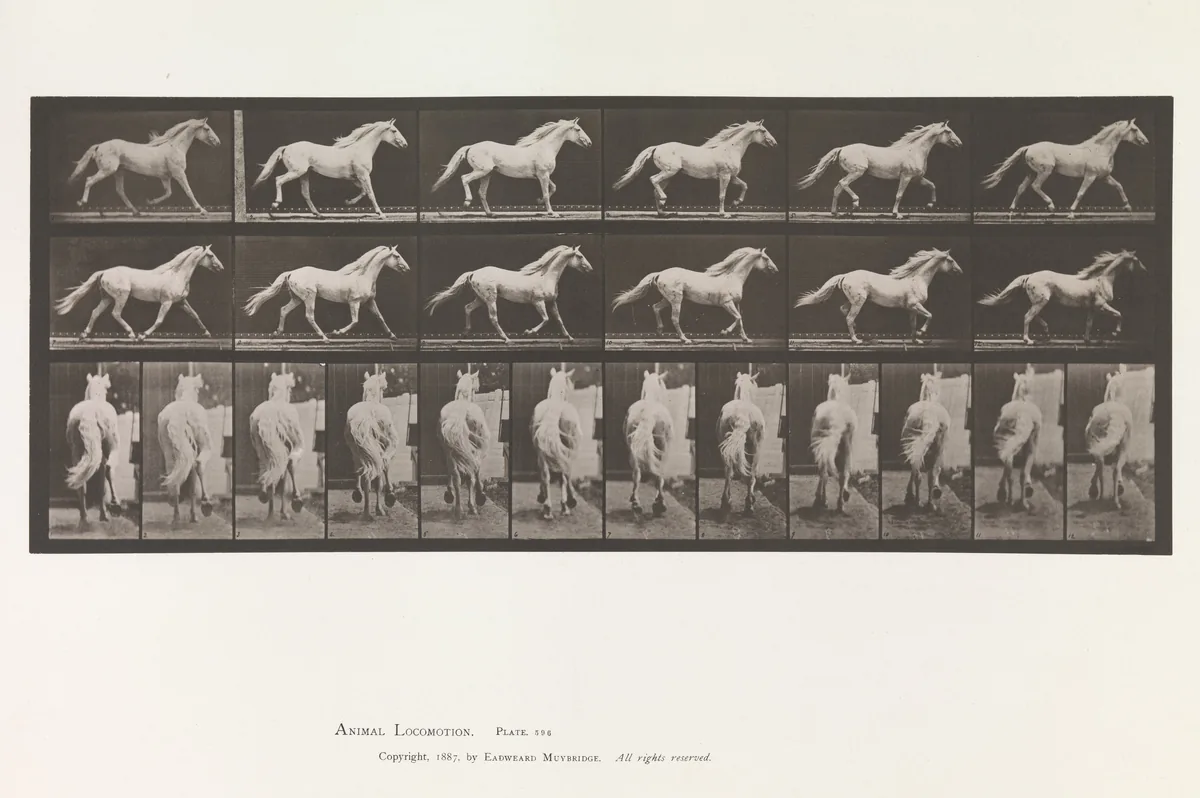
Use the second angle to test the first
In the plate of the pale horse, the dark field makes the legs easy to distinguish until one passes in front of another. A limb can appear to shorten abruptly in profile because another limb masks it. Look down to the end-on row and the apparent problem changes. The legs overlap in a different direction and the width of the body becomes easier to judge. Neither angle gives a complete account by itself. The printed margin between the rows marks a change in the evidence available to the eye.
Notice where the animal leaves the ground
Another sheet in the Met’s horses volume shows a mounted horse clearing an obstacle. Across the upper row its forelegs fold and extend, while lower views redirect attention to the obstacle and the space beside it. Hold a finger over the rider for one reading and over the horse’s lower legs for the next. The same exposures can describe the rider’s changing balance or the sequence of the jump. The page supplies the observations. Choosing which relationship to follow is the reader’s work.
A lesson for editing a burst today
Lay out a short burst from a single fixed camera in capture order. Mark the first frame where a foot clears the ground and the first where it touches down again. Now pick the frame that best explains the movement to someone who never saw it. That may be a moment of separation just before the most dramatic pose. Muybridge’s sheets offer something a lone peak-action image cannot provide on its own: the neighboring moments against which to test that choice.