From portrait studio to the street
Dorothea Lange began with the controlled rituals of studio portraiture. Born in Hoboken, New Jersey, in 1895, she apprenticed in New York before moving west and opening a San Francisco studio in 1919. Her clients were largely affluent, but the economic collapse outside the studio changed the direction of her work. By 1932 she was photographing unemployed people in the city. The White Angel Breadline picture of 1933, centered on one man turned away from the crowd, established a method she would keep refining: describe a large crisis through one person’s posture, distance and dignity.
Toward Los Angeles: a landscape that makes a judgment
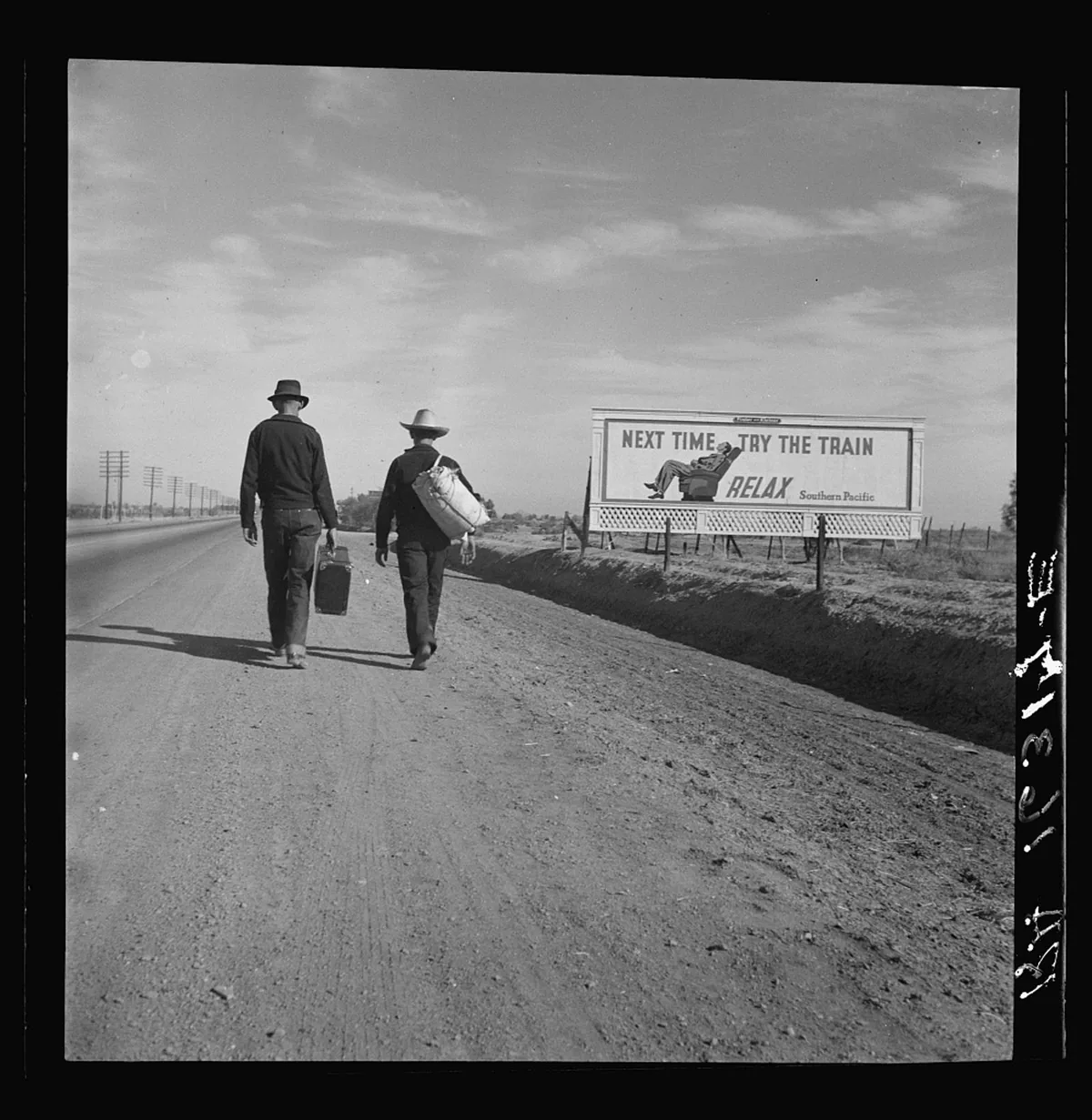
In Toward Los Angeles, California, two travelers walk away from the camera along a broad road. Their bags make the movement physical; the empty space makes it uncertain. Beside them, an advertisement reads “Next time—try the train,” a promise of effortless travel addressed to people moving on foot. Lange did not need to manufacture a symbol. She noticed how the figures, road and billboard already formed an argument about mobility, labor and exclusion. The picture is a lesson in including enough environment for circumstance to become visible.
The FSA assignment
In 1935 Lange joined the Resettlement Administration, later folded into the Farm Security Administration. The federal project sent photographers across the United States to document rural poverty, migration, tenant farming and the effects of the Depression. The pictures had an institutional purpose: they could help explain conditions to the public and support government programs. Lange’s contribution was not neutral in the sense of being detached. Her frames are formally controlled, but their clarity directs attention toward people whose lives were often reduced to statistics.
Migrant Mother was a sequence, not a single miracle
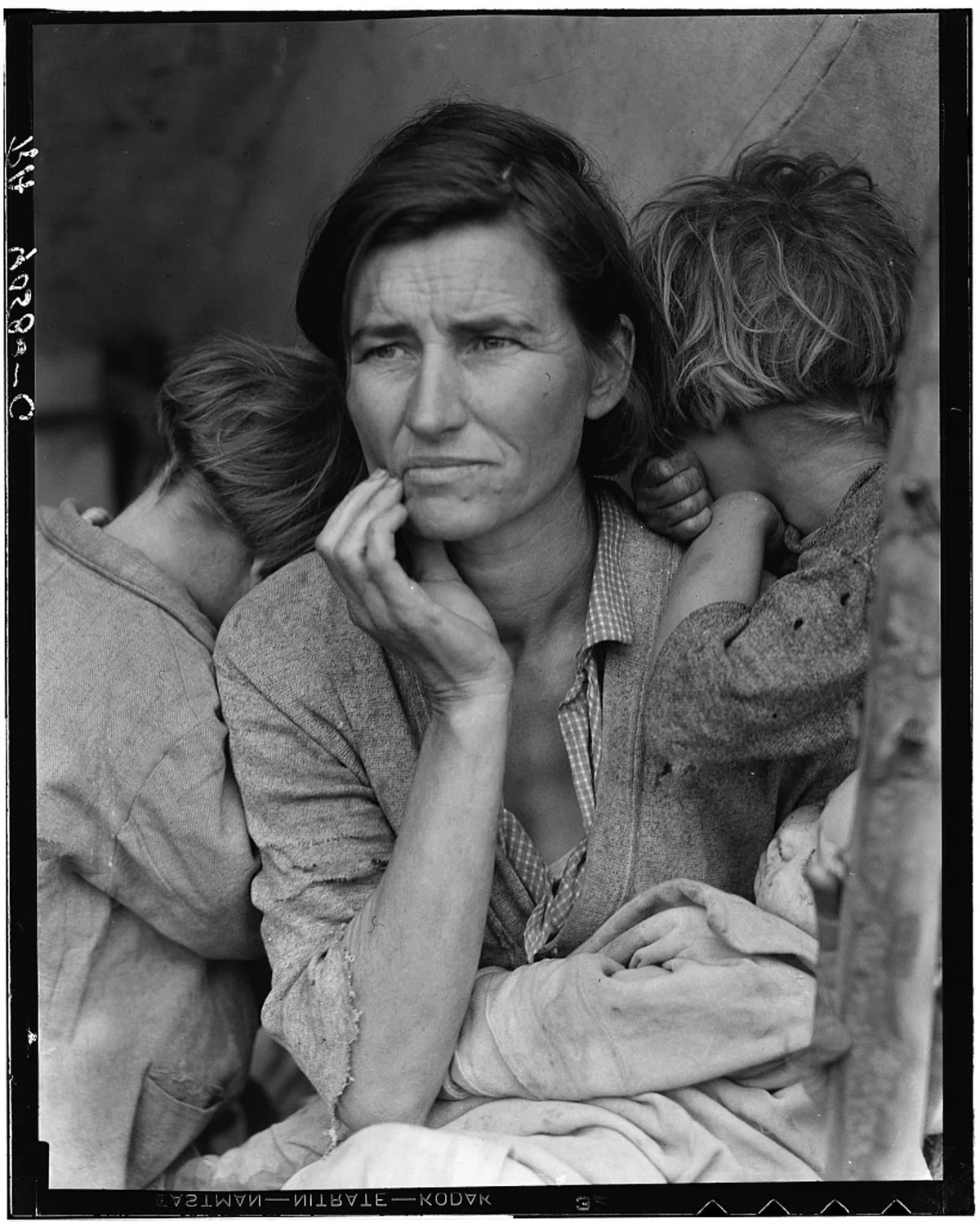
The photograph now called Migrant Mother was made in March 1936 at a pea pickers camp in Nipomo, California. The woman was Florence Owens Thompson, a 32-year-old mother of seven. Lange made six exposures, changing her distance and arrangement until the best-known frame concentrated attention on Thompson’s face, hand and three children. Remembering the sequence matters because it replaces the myth of instant genius with a more useful idea: a photographer works a situation, looks again and gradually finds the form that carries the story.
What the famous frame does
Two children turn their faces away, enclosing Thompson while withholding their own expressions. A baby rests below. Thompson looks beyond the camera, and her fingers touch a face marked by fatigue and concentration. The triangular arrangement is stable, yet every gesture communicates uncertainty. The background disappears enough that viewers meet the family first, but the caption restores place, date and economic circumstance. Image and text perform different jobs; together they turn a private moment into evidence of a national emergency.
The ethical question never disappears
The power of Migrant Mother has also forced later viewers to ask who benefits when another person’s hardship becomes an icon. Thompson’s name was not part of the original public caption, and the picture circulated far beyond the encounter that produced it. Studying Lange responsibly means holding formal admiration beside questions of consent, identification, agency and compensation. Documentary photographs do not stop being relationships once the shutter closes. Editors and photographers inherit obligations to the people represented, especially when an image becomes more famous than the life it depicts.
Photographing incarceration
During World War II, Lange worked for the War Relocation Authority and photographed the forced removal and incarceration of Japanese Americans. Her pictures recorded families with identification tags, businesses about to close, schoolchildren pledging allegiance and the infrastructure of confinement. The National Archives notes that much of this material was withheld from public view while the wartime program was operating, although it became available after the war. The assignment expanded the central tension in Lange’s work: a government photographer could create a record that complicated the government’s preferred story.
A field portrait of the photographer
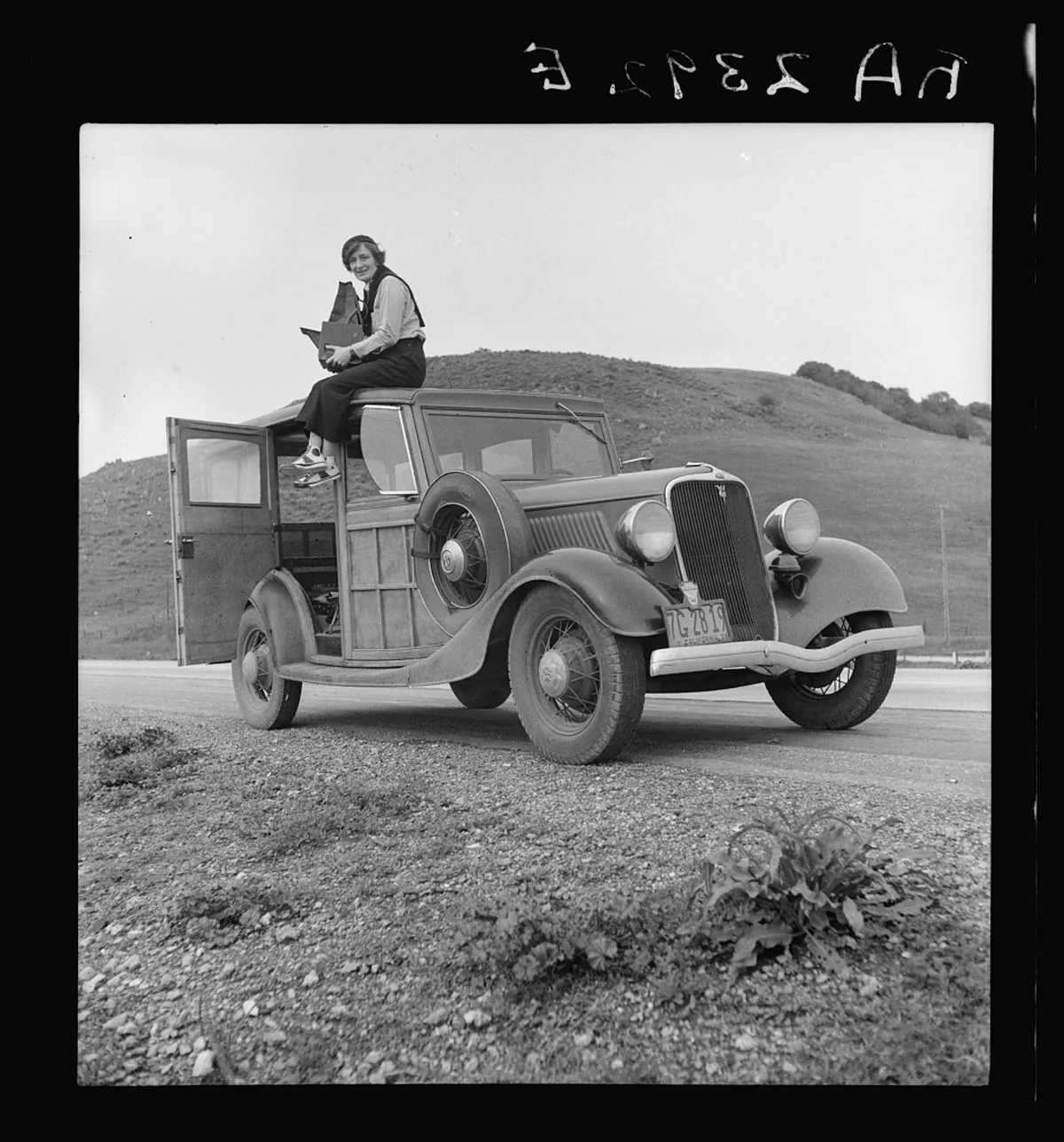
A 1936 photograph preserved by the Library of Congress shows Lange perched on the roof of a station wagon with a camera and notebook. It is an unexpectedly practical portrait. Documentary work depended on travel, conversation, captions and the patience to remain in a place after the obvious frame had been made. The car became transportation, office and vantage point. Lange’s legacy is therefore not only a recognizable visual style; it is a way of working in which attention and reporting are inseparable.
What photographers can learn now
Lange’s strongest pictures are composed with precision, but they do not advertise technique. The lesson is to move closer without erasing context, to notice the social meaning already present in a landscape and to keep captions as carefully as negatives. Make a sequence rather than betting everything on one frame. Record names and circumstances accurately. Return agency to the subject wherever possible. A documentary photograph gains authority not by looking grave, but by connecting a legible image to responsible information.