The setting cannot stand in for the story
Ansel Adams is closely associated with the American West, but the mountains in his Manzanar photographs surround a place of incarceration. During World War II, people of Japanese ancestry were forcibly removed from their homes and confined by the United States government. Adams photographed Manzanar in 1943 and 1944; a selection appeared in his 1944 book Born Free and Equal. Read the pictures with that history intact. Their carefully organized spaces and striking terrain are not evidence that confinement was benign or voluntary.
Begin with the view from the guard tower
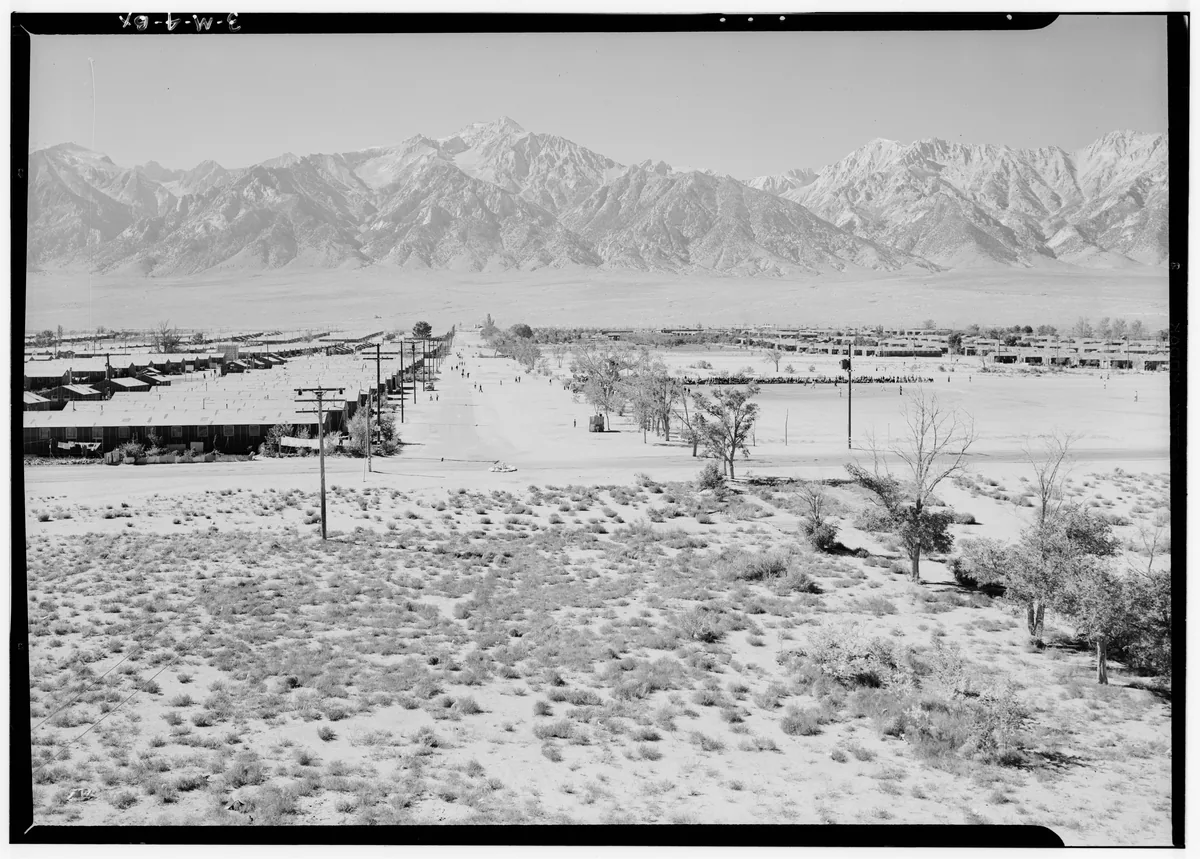
The Library of Congress identifies our opening image as a westward view from a guard tower, with the Sierra Nevada behind the camp. Notice how the road and repeated buildings carry the eye toward the mountains. The elevated position makes the camp legible as an arrangement of spaces rather than as a single encounter between people. That is a visual reading, not a claim about a particular exposure setting. The catalog title supplies something the attractive mountain outline alone cannot: the significance of the photographer’s vantage point.
Ask what the position permits and excludes
The National Park Service explains that Adams was not allowed to photograph the guard towers themselves and instead photographed from them. This makes the viewpoint part of the evidence. A tower need not appear within the border for its presence to matter. When studying the image, separate what you can directly see from what the source record establishes. Then ask what remains outside the frame. A clear, expansive photograph can still offer a restricted account of a place, especially when access is controlled by others.
Follow the rows, then find the people
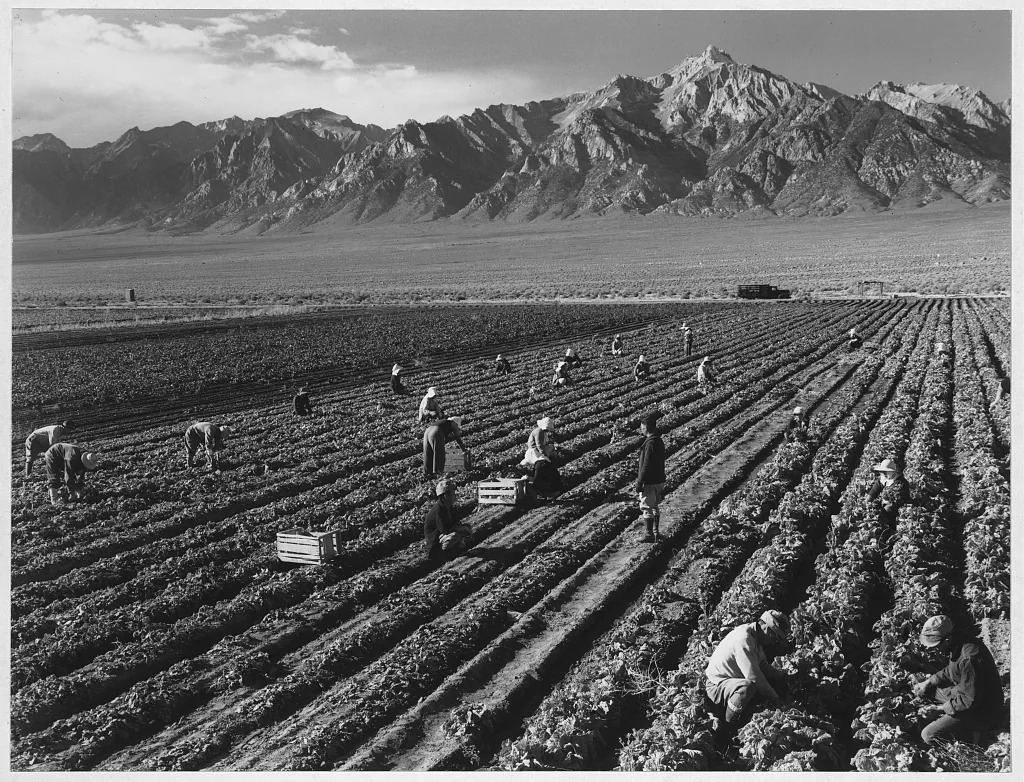
In the agricultural photograph, rows of crops run diagonally through the foreground while mountains hold the upper part of the frame. The workers interrupt that repeated pattern. Try looking first at the arrangement of lines, then at each person and the spaces between them. The second pass changes the emphasis from a beautifully organized landscape to people working within it. Neither reading requires guessing their thoughts. A responsible caption names the place and activity without treating visible effort as proof of consent to the circumstances in which it occurred.
A baseball game has more than one layer
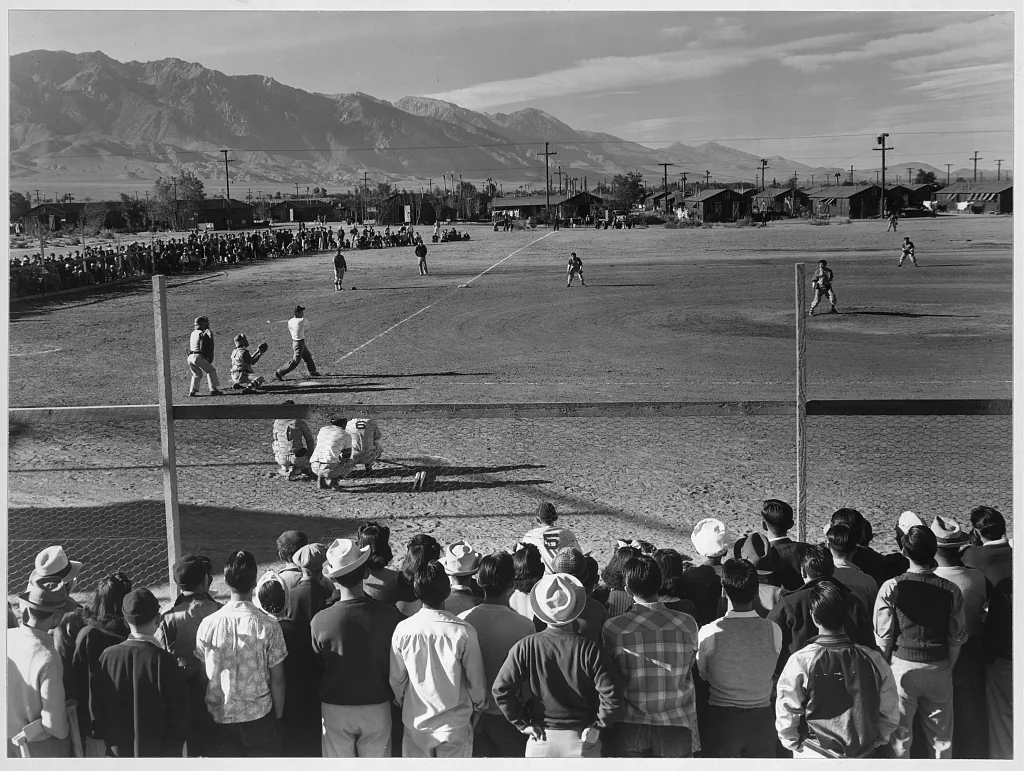
The baseball picture places spectators close to the viewer, players across the field and camp buildings beyond. The crowd creates a foreground through which we look rather than an empty strip below the action. Follow the field toward the distant buildings and mountain ridge, then return to the people nearest the camera. Community activity and incarceration coexist in the same image. The presence of recreation should not be used to cancel the coercive setting; nor should the history make the participants’ everyday lives invisible.
Compare the reproduction before judging the composition
The Library of Congress offers scans of original negatives and photographic prints for much of this collection. Those are not always interchangeable versions of the same border and tonal treatment. Our tower image is a negative scan; the farm and baseball images are print scans, with their visible borders retained. Use the linked catalog records to see what object you are examining. If you compare an online reproduction to a book, check the crop and source before attributing every difference to Adams’s original framing.
Study choices without inventing motives
A useful close-reading exercise is to write two short notes for each picture. In the first, describe only visible relationships: near and far, repeated forms, people, empty areas and the direction of your attention. In the second, add facts established by the catalog and historical sources. Keep interpretation distinguishable from both. This helps avoid two familiar shortcuts: reducing the work to a lesson in composition, or claiming that a photograph transparently explains everything about the people it depicts. Neither gives the image or its subjects enough attention.
Carry the lesson into your own captions
For contemporary documentary work, the practical lesson is not to imitate a mountain backdrop. It is to record the circumstances that a frame cannot communicate on its own. Note access restrictions, identify the location and activity accurately, and resist captions that turn a visible expression into an unsupported statement about a person’s experience. Adams’s Manzanar photographs reward formal attention, but their history demands more than admiration of form. Keep the people, the institutional setting and the limits of the photograph in view together.